
Presence is partly about scale
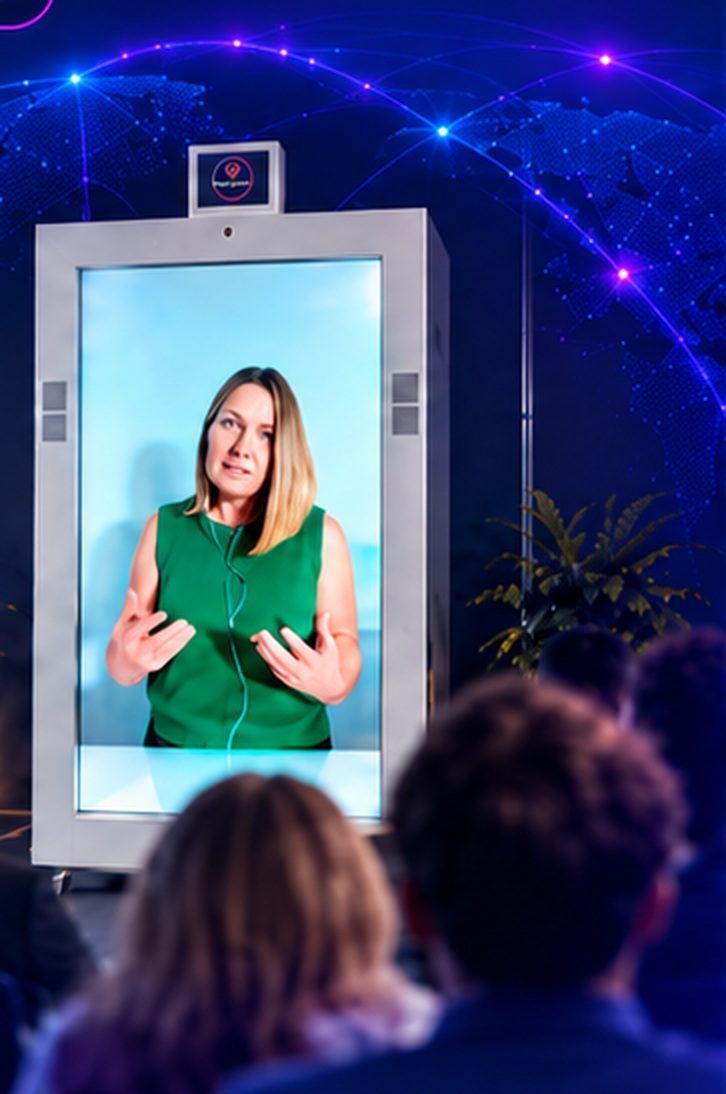
A conventional video call places the remote person inside a rectangle. Life-size telepresence still connects someone remotely, but presents them at human scale and gives the room a clearer place to orient toward them.
Good use of Feelspace should reduce friction rather than create it. If presence is partly about scale requires so much explanation or setup that the audience loses sight of the purpose, the design needs simplifying. The strongest version of “What changes when a remote person appears life-size in the room” is one where the technology supports the flow and then becomes secondary to the person, message or activity.
The room can be designed around the person
Chairs, a local host, a product, a panel or an audience can be arranged around the remote guest rather than around a laptop. That can change how naturally the person fits into a presentation, workshop or conversation.
There is also a consistency question. If the same idea will be used across several sites, teams or events, organisations should decide which parts must stay standard and which can adapt locally. In Behind Feelspace, the room can be designed around the person can often be designed as a repeatable core with room for genuine local interaction where that adds value.
It matters most when the person matters
If the purpose is simply to review a document, standard video is often enough. Feelspace becomes more relevant when the speaker, trainer, performer, specialist or family member is a central part of the experience.
The human behaviour around the technology matters just as much as the hardware. People need to know who the remote person is, why they are joining and what kind of interaction is expected. In “What changes when a remote person appears life-size in the room”, good preparation helps the audience focus on the person and the content rather than trying to work out how the system is supposed to be used.
Good session design still matters
Clear audio, sensible portrait framing, a reliable connection and a defined role for the remote person remain essential. Life-size presentation cannot compensate for an unclear session or poor preparation.
Preparation becomes easier when the session is broken into roles. The remote person needs to know what they are responsible for, the local host needs to know when to step in, and the audience needs a clear way to participate. Applied to “What changes when a remote person appears life-size in the room”, that role clarity can make good session design still matters feel deliberate rather than improvised.
The goal is practical presence
Feelspace is not designed to convince people that someone has physically teleported into the building. It provides another way to bring the right person into the room when distance, time, cost or access makes physical attendance difficult.
Preparation becomes easier when the session is broken into roles. The remote person needs to know what they are responsible for, the local host needs to know when to step in, and the audience needs a clear way to participate. Applied to “What changes when a remote person appears life-size in the room”, that role clarity can make the goal is practical presence feel deliberate rather than improvised.
Life-size telepresence is most useful when the person — not the screen — is the reason for the session.